Project Sinxay
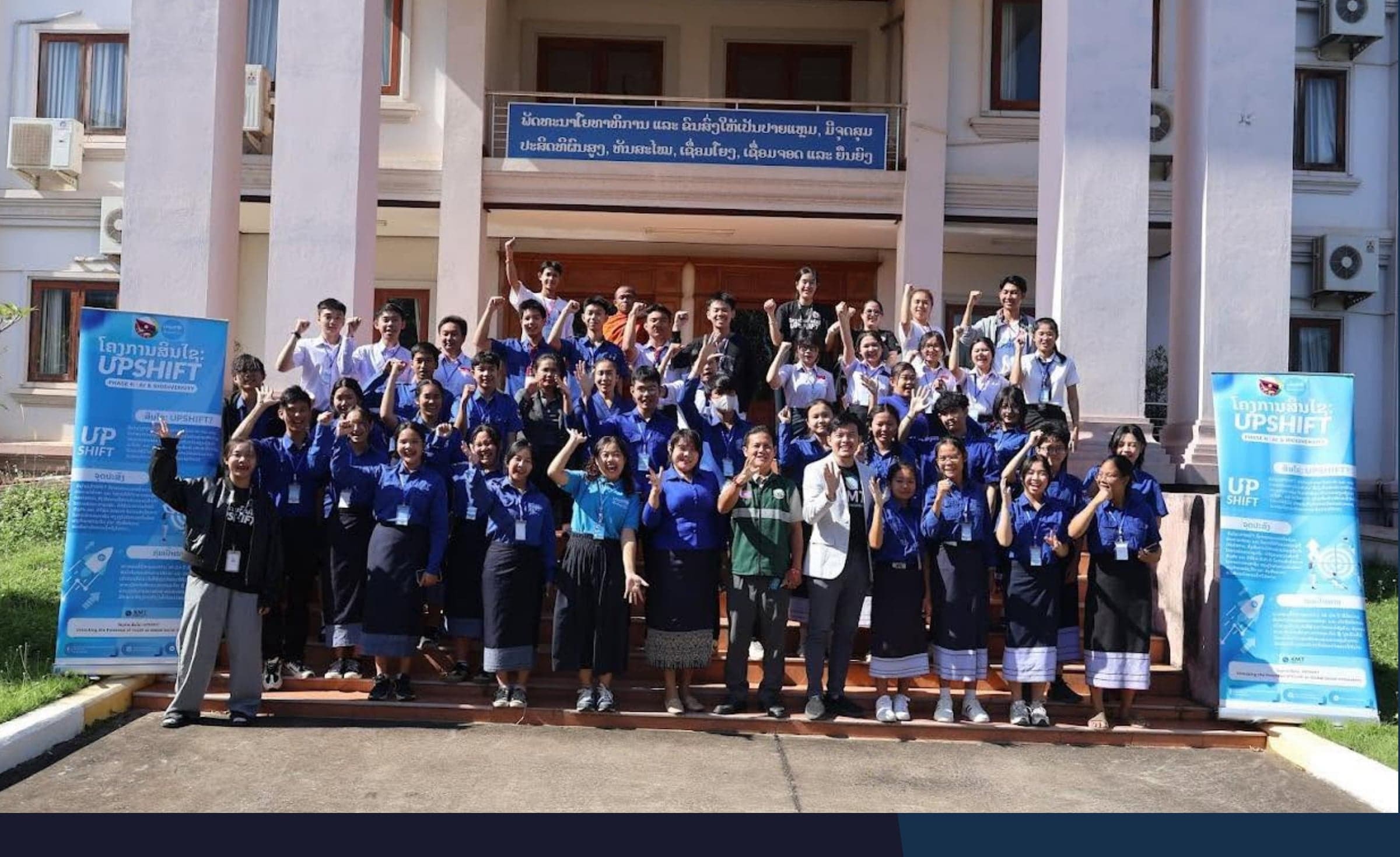
Sinxay UPSHIFT participants and staff celebrating together on the steps of a government building, many raising a fist in the air, with UPSHIFT roll-up banners on either side.

Youth-led change in Lao PDR

Project Sinxay

Young ideas. Local action. Shared future.

A youth-led journey connecting mentoring, advocacy and social innovation — from first ideas to community action across Lao PDR.

Photo: XM Technovator for UNICEF Lao PDR — Sinxay UPSHIFT Impact Report 2025-2026

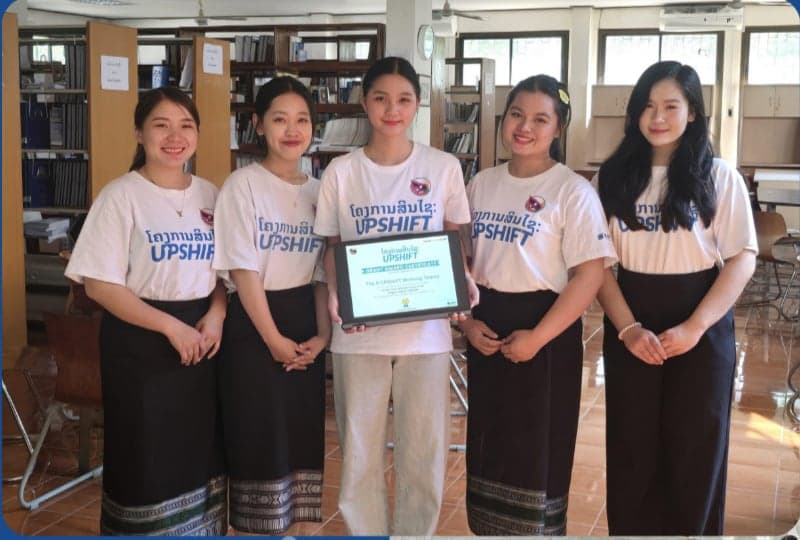
Team Dreamer, the Green Market project from Luang Prabang — five young women in white UPSHIFT shirts and traditional Lao sinh skirts, one holding their grant certificate, photographed in a library.
Photo: XM Technovator — UPSHIFT 9 Winning Project Info Catalog

What is Project Sinxay?

Project Sinxay is a youth empowerment initiative in Lao PDR connecting mentoring, advocacy and social innovation. Three programme tracks run independently and feed one another: Sinxay Mentors, Youth Champions, and Project Sinxay: UPSHIFT.

Key numbers

162
Direct youth participants

F 107 · M 55

214
Reported beneficiaries

As reported: 162 direct youth participants plus 52 teachers, officials and guests.

31
Youth-led social innovation projects developed
9
Winning projects implemented
24
Youth-led social innovation projects developed

Sinxay Mentor

Data currently being compiled

Statistics for this track are currently being compiled. Explore the stories and activities while the full dataset is prepared.

Sinxay Youth Champion

Data currently being compiled

Statistics for this track are currently being compiled. Explore the stories and activities while the full dataset is prepared.

Three connected initiatives

Select a track to follow its journey. All three journeys stay visible.

Sinxay Mentor

  1. 1

    Recruitment and preparation

    Experienced young people are identified at provincial level and prepared for a mentoring role.

  2. 2

    Cascade training

    Mentors are trained so they can in turn train and support others in their province.

  3. 3

    Peer-to-peer mentoring

    Mentoring runs as a sisters-and-brothers relationship rather than a top-down instruction.

  4. 4

    Coaching youth advocates

    Mentors give practical guidance to youth advocates running their own initiatives.

  5. 5

    Troubleshooting and motivation

    Mentors help unblock stalled projects and keep momentum through difficult stretches.

  6. 6

    Community implementation

    Support continues while projects are put into practice at community level.

Sinxay Youth Champion

  1. 1

    Youth advocacy training

    Young people take part in training on advocacy skills and the issues they will go on to raise with their peers.

  2. 2

    Leadership and communication

    Champions build the leadership, public speaking and facilitation skills needed to run activities with their peers.

  3. 3

    Issue identification

    Champions identify which issues matter most in their own school or community, drawing on topics such as child marriage, climate change, and sexual and reproductive health.

  4. 4

    Community dialogue

    Champions lead peer-to-peer sessions and open dialogue with classmates, families and community members on the issues they have identified.

  5. 5

    Youth-led advocacy

    Champions plan and carry out their own advocacy activities in schools and communities, putting what they have learned into practice.

  6. 6

    Seed-funded action where applicable

    Where seed funding is available, selected advocacy initiatives receive a small grant to help put their plans into action.

Sinxay UPSHIFT

  1. 1

    Understand the community problem

    Youth teams start by exploring a real problem in their own community and why it matters.

  2. 2

    Research stakeholders

    Teams talk to the people affected by the problem to understand it from different points of view.

  3. 3

    Define the challenge

    Teams turn what they have learned into a clearly defined challenge they can design a solution for.

  4. 4

    Develop an idea

    Teams generate and choose an idea that responds directly to the challenge they have defined.

  5. 5

    Prototype and test

    Teams build a simple prototype of their idea and test it with real users before refining it.

  6. 6

    Pitch the solution

    Teams present their solution to a panel, explaining the problem, the idea and the evidence behind it.

  7. 7

    Receive mentorship and funding

    Selected teams are paired with a mentor and receive seed funding to help develop their solution further.

  8. 8

    Implement the project

    Funded teams put their project into practice in their own community.

Where the work happens

Project Sinxay: UPSHIFT has run in three provinces. Select one to see the youth-led projects it produced.

Luang PrabangSavannakhetVientiane Capital

This map is for reference. Select a province from the list to explore its projects.

Province boundaries: geoBoundaries (CC BY 4.0)

From community challenge to youth-led action

After

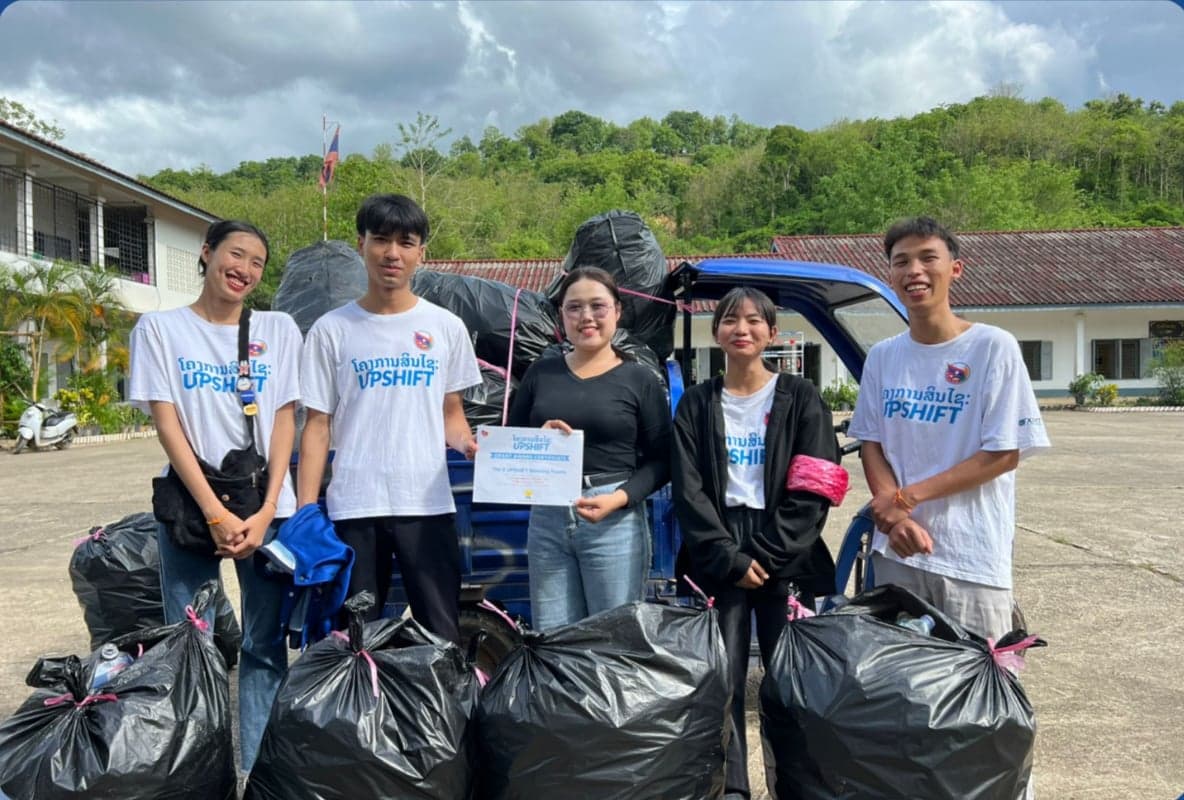
Team Yolo, the Zero Crew project from Luang Prabang — five participants standing outdoors beside a truck loaded with bagged plastic bottles collected through their bottle-exchange programme.
Photo: XM Technovator — UPSHIFT 9 Winning Project Info Catalog
Sinxay UPSHIFTLuang Prabang

Zero Crew — a bottle exchange that pays it forward

Challenge
Plastic bottle waste accumulating in schools in Luang Prabang, with no separation habit and no incentive to collect it.
Youth insight
Team YOLO saw that students would separate waste if collecting it earned something tangible, and that the reward itself could be redirected to schools with fewer resources.
Action
A "Bottle Exchange" system where students and volunteers trade used plastic bottles for snacks or school supplies, which are then donated to under-resourced schools.
Outcome
Collected 103 kilograms of plastic water bottles over two months, and donated 10 complete sets of school cleaning supplies — two-handle brooms, single-handle brooms, dustpans and blackboard erasers — to the Special Education School of Luang Prabang Province.

After

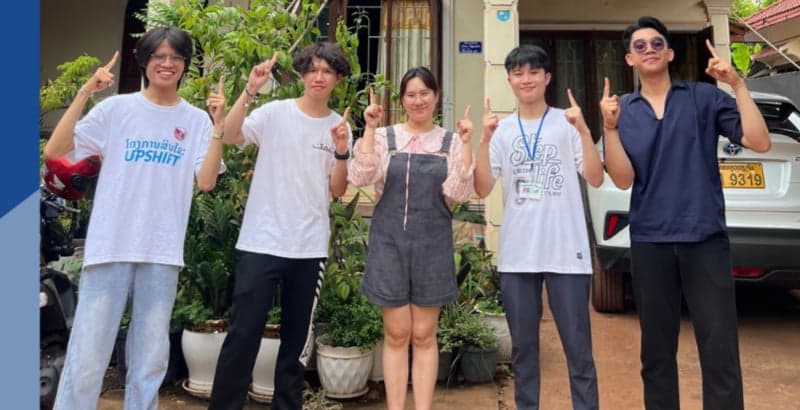
Team Shark4, the SalaSara project from Vientiane — five participants posing outdoors in front of a house and car, each pointing upward.
Photo: XM Technovator — UPSHIFT 9 Winning Project Info Catalog
Sinxay UPSHIFTVientiane Capital

Salasara — piloting the first "green temple" in Laos

Challenge
Communities around Vientiane generate organic wet waste with few practical ways to manage it, while temples — trusted and central to daily life for Lao people — were not yet being used as a channel for environmental action.
Youth insight
Team Shark4 saw that sustainable change starts from small points nearby, and that turning a respected temple into an environmental hub could let the community manage its own waste, generate income and spread the model further.
Action
The team chose Wat Mai Sok Kham as the starting point for the first "green temple" in Laos, organising a training session on wet waste management and composting and building two composting bins on the temple grounds.
Outcome
Trained 20 volunteers and community members in wet waste management and composting, built two composting bins at Wat Mai Sok Kham, and secured a media partnership with the Kaabia Page to help the model reach further.

After

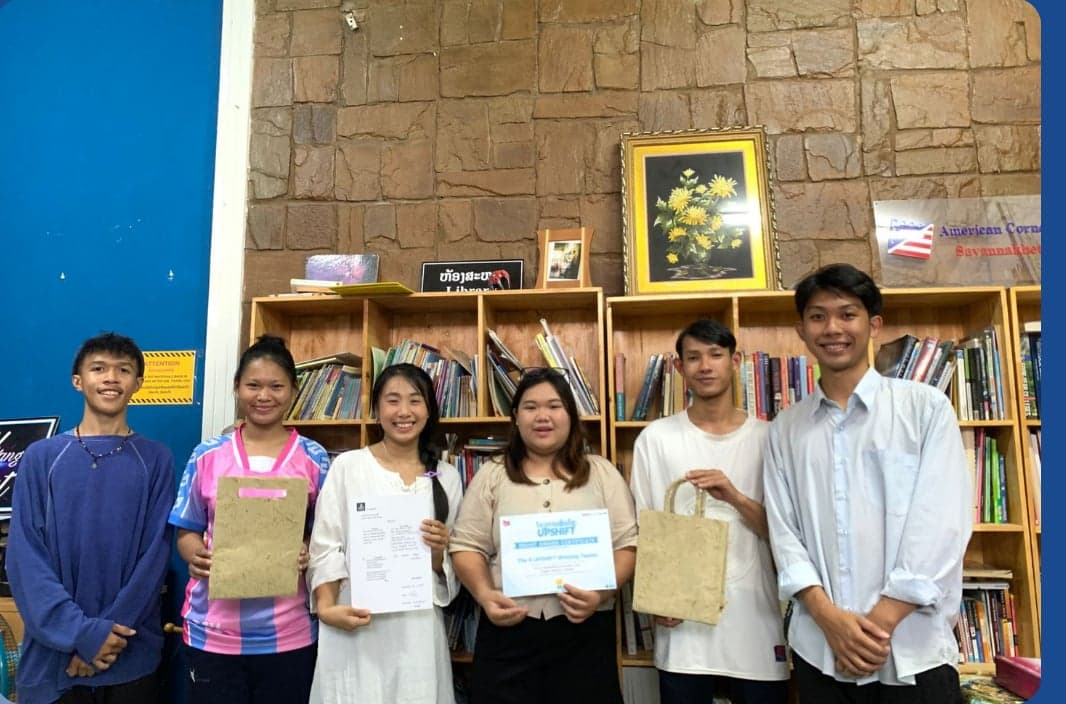
The Phoenix Fold team, the Eco Rice Straw project from Savannakhet — six participants standing indoors in front of a bookshelf, two holding eco-friendly paper bags made from rice straw and one holding their grant certificate.
Photo: XM Technovator — UPSHIFT 9 Winning Project Info Catalog
Sinxay UPSHIFTSavannakhet

Eco Rice Straw — from a burning habit to a bag on a shop shelf

Challenge
Rice farming is central to life in Sok Village, Savannakhet, but the traditional practice of burning leftover rice straw contributes to PM2.5 air pollution and damages soil quality in the area.
Youth insight
The Phoenix Fold saw that rice straw did not have to be waste at all — treated as a raw material, it could become eco-friendly paper products, keeping it out of the fire and turning it into income.
Action
Under the concept "From Waste to Wealth," the team developed production techniques to turn rice straw into handmade paper, created paper bags in three sizes, and built a small business model around the products.
Outcome
Gained more sustainable production techniques, launched paper bags in three sizes (including a 16.5 by 25 centimetre size), significantly increased the quantity of paper produced, and found two partner shops to stock the products.

Skills the programme builds

22 skills shown

Illustrative skill map based on documented programme activities; not a participant performance ranking.

Select a skill to read what it means in this programme.

Projects and reports

  1. Completed

    Phase 1

    2024–2025

    9 winning projects

    • Zero Crew
    • Green Market
    • Breath of Fresh Air
    • Salasara
    • Black Soldier Fly
    • STOAF
    • Eco Rice Straw
    • No Waste, Better Drain
    • ODOR.X
  2. Running now

    Phase 2

    2025–2026

    9 winning projects

    • Green Legacy
    • Good Soil Station
    • Better Bee Better Life
    • Smart Oil-Water Separation
    • MediKhong
    • Jaopeek
    • CleanBurn
    • Know More Crocodile, Know More Ecosystem
    • NatureRise

    Applications are not open through this site yet. The application route is being confirmed with the programme team.

  3. Not yet open

    Next phase

    A further phase has not yet been announced with confirmed dates. This page will be updated when it is.

Sinxay UPSHIFT · 2026

UPSHIFT Phase II Completion Report

EN

XM Technovator for UNICEF Lao PDR

This report is being prepared for online reading. The source reference is available, but the downloadable file has not yet been connected.

Sinxay UPSHIFT · 2025

Understand AI UPSHIFT

EN

XM Technovator

Sinxay Youth Champion · 2019

UNICEF Youth Advocacy Guide

EN

UNICEF

Partners

Project by

  • UNICEF Lao PDR
  • Lao Youth Union

Partners

  • XM Technovator